

CIEM Security Best Practices: 5 Steps to Success


CIEM Security Best Practices: 5 Steps to Success
This blog explains how to make CIEM actionable and practical, offering steps to successful cloud infrastructure entitlement management and providing an overview of how BeyondTrust operationalizes CIEM best practices for organizations of all sizes.
What is Cloud Infrastructure Entitlement Management (CIEM)?
The concept of cloud infrastructure entitlement management (CIEM) emerged as teams became more distributed across the globe, causing companies to move from on-prem to hybrid and / or multicloud approaches.
As organizations increasingly span more than one cloud, cloud and SaaS environments become much more unruly to manage without CIEM solutions. Identities (human and machine), roles, and secrets multiply as teams adopt new technologies.
One recent research report claimed AWS has 18,000+ possible permissions to manage, and the average AWS cloud environment contains over 3,000 over-permissive access policies. And that’s just one cloud environment; in 2026, 81% of organizations are relying on two or more cloud providers to run critical workloads, with nearly a third of respondents (29%) relying on three or more.
In many cases, such as in cloud migration projects, identities live on past their original intended use cases. For instance, Orca Security found that 78% of organizations have at least one IAM role that hasn’t been used for 90+ days.
This risk only continues to scale up as organizations grow. With each new project or platform, more users, tools, and identities get high levels of admin access to keep things moving. This unchecked access is convenient but risky, leading to privilege creep and hidden paths to privilege escalation.
BeyondTrust's identity security risk assessment, which is performed on real-world organizations across a variety of industries, regularly uncovers overprivileged cloud / SaaS accounts. Such detections include:
Overly permissive Entra Service Principals able to escalate to Global Admin privileges
Hidden privilege escalation paths to Active Directory, Entra, AWS, Okta, and GitHub built on configuration oversights
Active Directory accounts holding privileged Entra roles
And many more
CIEM solutions provide a streamlined technological answer to these identity challenges in cloud and hybrid environments, enabling teams to see, manage, and prove that cloud identities are under control.
This blog will explain how to make CIEM actionable and practical, and provide an overview of how BeyondTrust operationalizes CIEM best practices for organizations of all sizes.
5 CIEM Security Best Practices for Cloud Infrastructure Success
A successful CIEM approach focuses on depth and breadth: discovering, managing, and protecting identities, and seamlessly working alongside other identity security technologies to gather and apply context about the entire IT estate. Here are some best practices to adopt:
1. Assess & Map (Cloud Identity Visibility)
Start by understanding which identities exist and how access actually works. Visibility starts by inventorying human, machine, workload, AI agent, and third-party identities across cloud environments. Additionally, map roles, policies, keys, and secrets, then visualize relationships and privilege escalation pathways to expose blast radius risk.
2. Design Guardrails (Cloud Least Privilege)
Take steps to reduce identity risks. Start by identifying and right-sizing unneeded, high-risk cloud permissions. You can do so by replacing broad roles with scoped access that aligns with each role’s required tasks and workflows. Additionally, consider creating pre-approved access bundles that reflect how long a real-world identity actually needs access to a given resource (e.g., DB read: 1 hour, Kubernetes cluster admin: 30 minutes).
3. Automate JIT Access (Enablement)
Make secure access easy—not painful. Look for ways to integrate with existing tools, such as enabling users to request access through the tech they already use, such as Slack, Teams, or CLIs. Automating access to be time-bound and auto-revoked also simplifies the user experience. Lastly, focus on tightly controlling and logging break-glass scenarios.
4. Operate & Prove (Compliance)
Leverage CIEM tooling to track evidence for every access decision: who requested it, who approved it, what was granted, how long it lasted, and which actions were taken. Keep it all centrally stored and ready to meet auditing and compliance requirements.
5. Improve Continuously (Feedback Loop)
Use the data from the previous steps to right-size access and fix configuration drift over time. Update policy rules in one place to apply changes at scale. Additionally, consider how you will integrate new threat research, so your access model stays ahead of how attackers and environments change.
Why CIEM Matters for Multicloud
CIEM matters to cloud / multicloud organizations because it helps them right-size overprivileged identities and shrink the overall identity attack surface, without causing operational disruptions or hindering productivity.
When IT teams attempt to right-size privileges, pushback is common. After all, nobody wants to lose access, and when they do need access, they can’t get it without pestering the service desk. It’s a lose / lose situation, putting security at odds with productivity.
Moreover, security teams are spread thin across many consoles. Native cloud IAM and reporting tools seem like a convenient way to save costs, but each only sees its own slice. If you’re like many others, you’ve stitched dashboards together, merged reports, and are still missing the big picture of who can do what across clouds.
The key goals of CIEM are to unify cloud permissions visibility and controls, automate policy creation and enforcement, and implement just-in-time (JIT) access workflows that improve security and workforce efficiency. Effective CIEM also enables organizations to discover and inventory identities that might have been created outside the purview of the IT team. Put simply, CIEM offers a consolidated approach to cloud access governance.
Integrating CIEM with other identity security technologies like PAM and ITDR also extends its effectiveness on revealing privilege pathways that cross domains (e.g., what if a bad actor can traverse from an on-premises environment into your cloud instance?).
What are Some Common CIEM Use Cases?
Common CIEM use cases include:
Uncovering which identities—human or non-human—have access across a cloud / multicloud environment. Unlike the native tooling offered by your specific cloud providers, CIEM sheds light on all your cloud environments. Plus, when combined with other identity security solutions like PAM and ITDR, CIEM helps address identity security holistically, including on-premises.
Reducing the cloud attack surface by limiting which identities can do what, and when. Always-on permissions (standing privileges) and other identity misconfigurations are a recipe for disaster. If an attacker gains control of a cloud identity with excessive privileges or hidden privilege pathways, they could easily escalate privileges or move laterally, increasing the blast radius of an attack—all under the guise of a legitimate user.
Supporting compliance by tracking each identity’s activity and cloud permissions at any given time. CIEM solutions create comprehensive audit trails that show actions across multiple cloud environments, meaning you don’t have to cross-reference data from your individual cloud providers for reporting and auditing.
How BeyondTrust Supports CIEM Security Best Practices
The BeyondTrust CIEM solution is powered by Identity Security Insights® and Entitle, enabling a balance of security and productivity for today’s cloud teams. Our Pathfinder platform unifies these solutions into a single console approach, offering cross-domain visibility and management that combines CIEM with industry-leading PAM and ITDR.
Here are some of the powerful security and productivity-enhancing CIEM capabilities customers unlock with BeyondTrust:
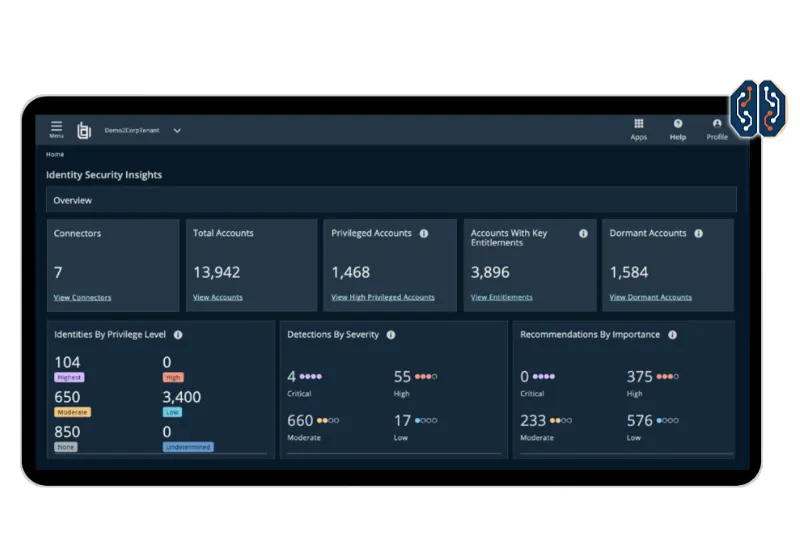
Discovery and Risk Prioritization
With Identity Security Insights, gain complete visibility into your entire IT estate and flag risky privilege pathways that cross domains. Enable CIEM capabilities such as:
Multicloud identity / permission inventory: Discover the identities across your entire IT estate
Permission mapping: See all Paths to Privilege™ in a visualized map, revealing hidden or indirect pathways that could be used to escalate privileges or cross domains
Toxic-combo detection: Surface risks such as stale keys / roles
Risk scoring: Prioritize alerts and remediate the most pressing cloud identity risks first
Cloud Access Enablement and Permissions Control
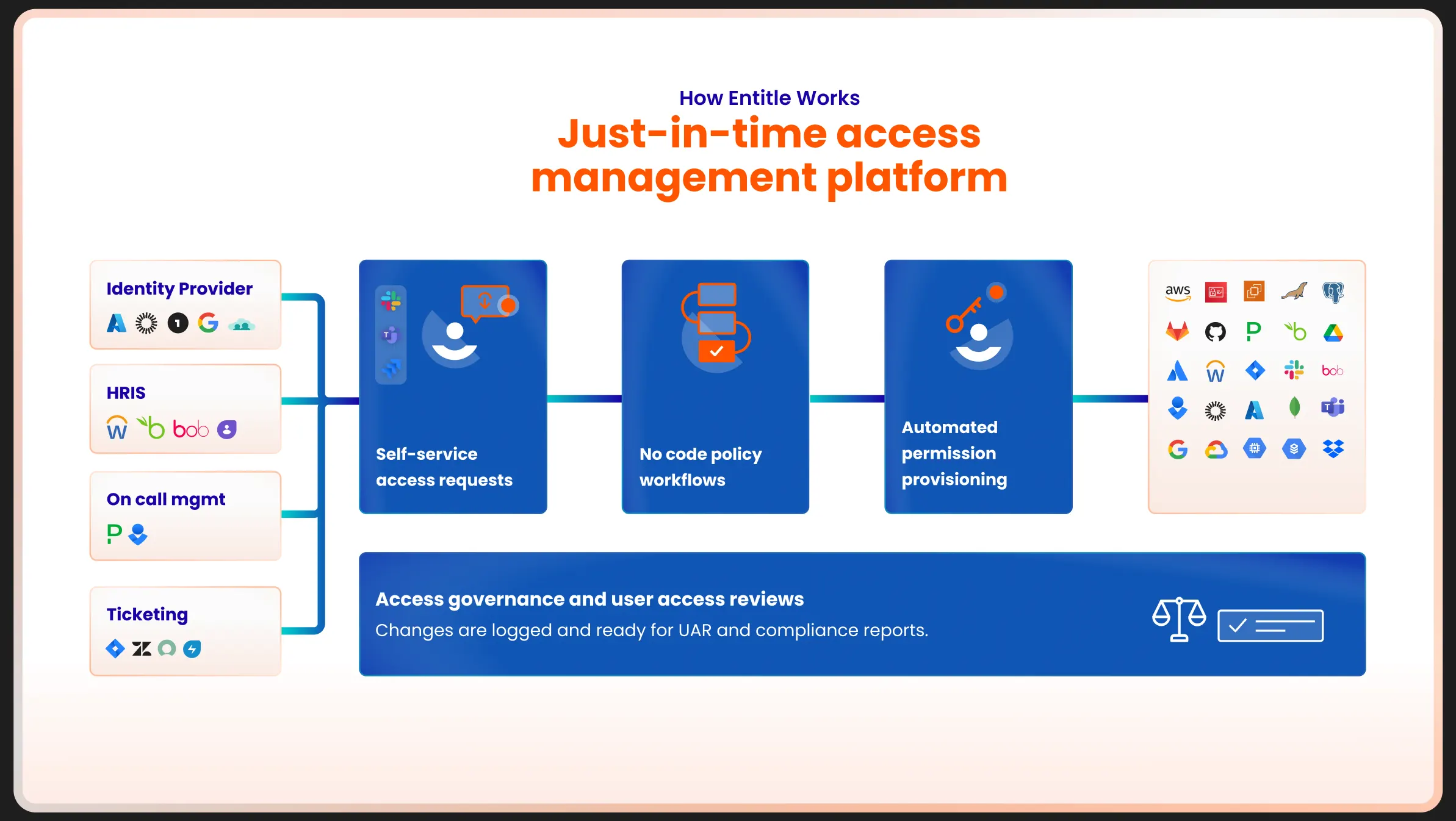
With Entitle, simplify and streamline the process of granting / revoking multicloud permissions, without compromising on productivity. Enable CIEM capabilities such as:
Bundled resources: Build pre-approved JIT bundles with privilege time limits and auto-revoke capabilities
Automated approvals: Leverage policies for automating approval (risk, requester, resource)
Seamless integrations with existing tech: Implement Slack / Teams / CLI flows that allow users to either request access from the tools they’re already using, or automatically obtain access within their existing workflows
Secure emergency access: Enable secure break-glass access with full audit trails
Hygiene recommendations: Access usage-based, right-sizing recommendations
Beyond CIEM with the BeyondTrust Pathfinder Platform
When you leverage Identity Security Insights and Entitle within the BeyondTrust Pathfinder platform, gain enhanced privilege-centric identity security across domains, including capabilities such as:
Unified view of cross-domain privilege pathways, such as on-prem to cloud
Automatically triggered containment (disable, revoke, quarantine) from detections
Evidence mapping to compliance and incident response playbooks
By shedding light on the True Privilege™ of every human and non-human identity across every environment (including multicloud and SaaS), Pathfinder expands your cross-domain visibility, breaks down silos, and empowers organizations to eliminate hidden identity risk, everywhere.
Get started on your CIEM journey today with our free, award-winning identity security risk assessment and uncover risky privilege pathways such as standing cloud permissions, unused admin accounts, entitlements that indirectly lead to privileged access, and other risks.
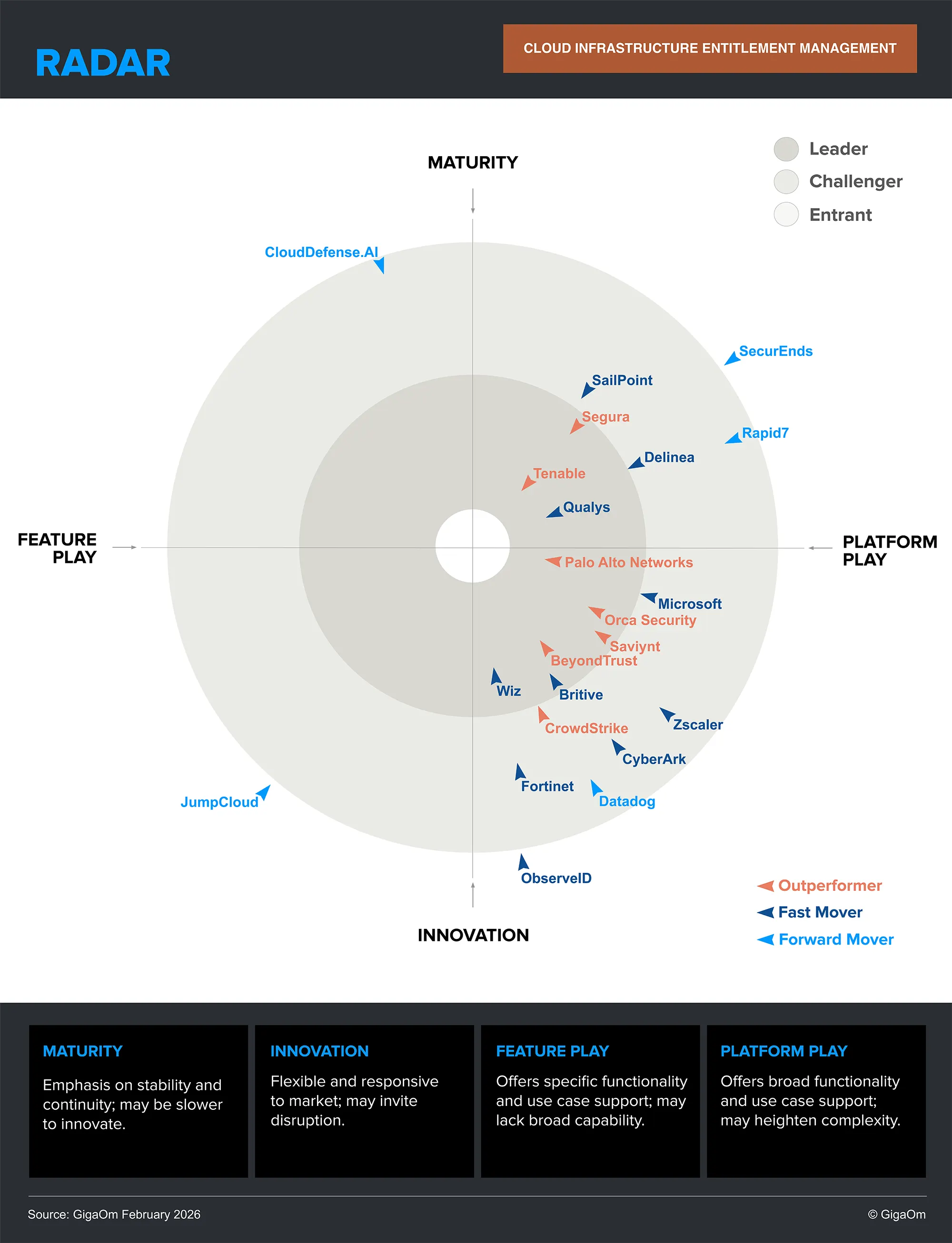
BeyondTrust Recognized in the 2026 GigaOm Radar for Cloud Infrastructure Entitlement Management (CIEM)
BeyondTrust's solutions were recognized as a Leader and Outperformer in the 2026 GigaOm Radar for Cloud Infrastructure Entitlement Management (CIEM).
FAQs
CIEM is needed by organizations that operate in hybrid or multicloud environments with rapidly proliferating identities, roles, and permissions. It enables these teams to better monitor and control the identities across multiple cloud domains.
CIEM protects against risks created by misconfigured cloud identities, such as overprovisioned, always-on permissions and identity sprawl. These security gaps could enable an attacker to move laterally or escalate privileges, increasing the blast radius of their attack with a legitimate account.
CIEM benefits teams that operate in hybrid or multicloud environments by discovering all identities and their associated permissions across cloud domains, reducing the cloud attack surface, and simplifying the process of granting / revoking permissions without negatively impacting productivity.
CIEM helps with compliance and audits by creating comprehensive audit trails and logging activity across multiple cloud environments.
Effective CIEM solutions include features such as:
Multicloud identity and permission discovery
Permission mapping and visualization
Risk prioritization through scoring and toxic-combination detection
Least-privilege guardrails using usage-based insights
Just-in-time access with automated approval and revocation
Integration with existing tools (e.g., Slack, Teams, CLI)
Centralized audit trails for compliance and incident response
CIEM is critical for cloud security in regulated industries because the technology creates comprehensive audit trails of every access decision. CIEM solutions track each identity's activity and cloud permissions at any given time across multiple cloud environments. Organizations leverage CIEM tooling to track evidence for who requested access, who approved the request, what the system granted, how long the access lasted, and which actions the user took. Keeping this data centrally stored ensures organizations meet strict auditing and compliance requirements without cross referencing individual cloud providers.
About the Author
David van Heerden
David van Heerden, A general nerd, metalhead, and wannabe film snob, has worked in IT for over 10 years, sharpening his technical skills and developing a knack for turning complex IT and security concepts into clear value oriented topics. At BeyondTrust, he's taken the Sr. Product Marketing Manager role to lead Entitle's marketing strategy.