

Assessing PAM Tools and Your Next Step in Privileged Access Management


Assessing PAM Tools and Your Next Step in Privileged Access Management
Identity is the new perimeter — and privileged access management (PAM) is the keystone of modern identity and access security. No identities—human or machine—are more imperative to secure than those with privileged access to systems, data, applications, and other sensitive resources.
Beyond that, PAM is also essential for protecting your entire identity infrastructure, including your backend IAM/IGA tools themselves.
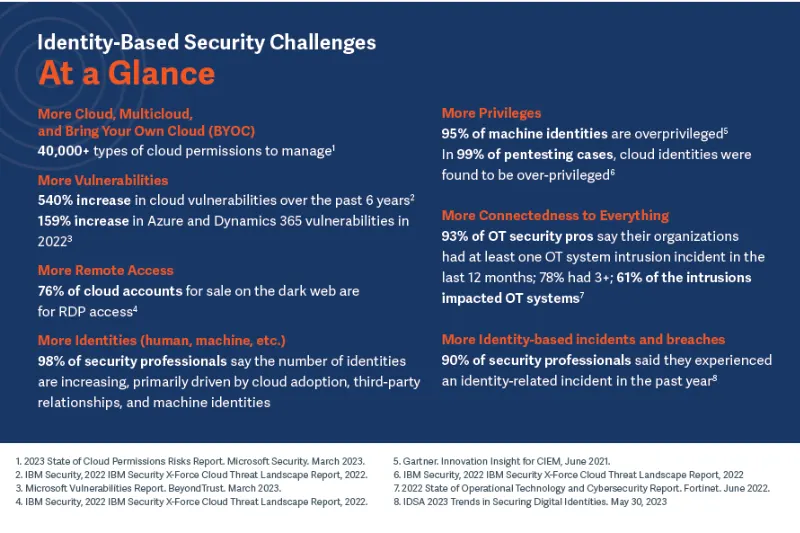
Attackers are rapidly advancing in agility beyond just simple automation. Machine learning (M/L) and Artificial intelligence (AI) are changing the game, vastly enhancing attacker toolsets and empowering human-operated attacks. Generative AI is in its nascent stage, but already is helping attackers accelerate their workflows, while becoming more targeted and sophisticated. For instance, attackers are using AI to execute multi-step social engineering exploits to impersonate identities and their attributes. And of course, it’s just as important for organizations to protect their own AI and M/L data from being stolen or poisoned.
Yet, the fact remains that almost every attack today requires privilege for the initial exploit or to laterally move within a network. Here’s one simple but highly illustrative proof point of the modern privilege challenge: In 99% of pentesting cases conducted by IBM’s X-Force Red, cloud identities were found to be over-privileged, enabling the pentesters to quickly compromise client cloud environments.
How to Assess Your Privileged Access Security Needs: A PAM Buying Guide & Comparison Checklist
To help security buyers clearly understand the problems PAM can solve and how deploying privileged access management capabilities translates into concrete business outcomes, BeyondTrust has published a completely updated edition of our Buyer's Guide for Complete Privileged Access Management (PAM). Use this comprehensive asset to assess your privileged access security needs and map them to modern privilege management solutions.
The Guide starts with the PAM basics that will mitigate most risks, then delves into other significant use cases, finishing with emerging use cases you should know. Our experience over many thousands of deployments has shown that there is a fairly typical path that most customers follow, but ultimately, your next steps in PAM will depend on where you are now, and the risk-based decisions that inform your goals.
Use The PAM Buyer’s Guide to help you answer:
Where to begin your privileged access management (PAM) project
How to progress to a better security posture
What business outcomes to expect by implementing various PAM and identity security controls
What a complete solution looks like (hint, it goes beyond traditional PAM to incorporate CIEM and ITDR)
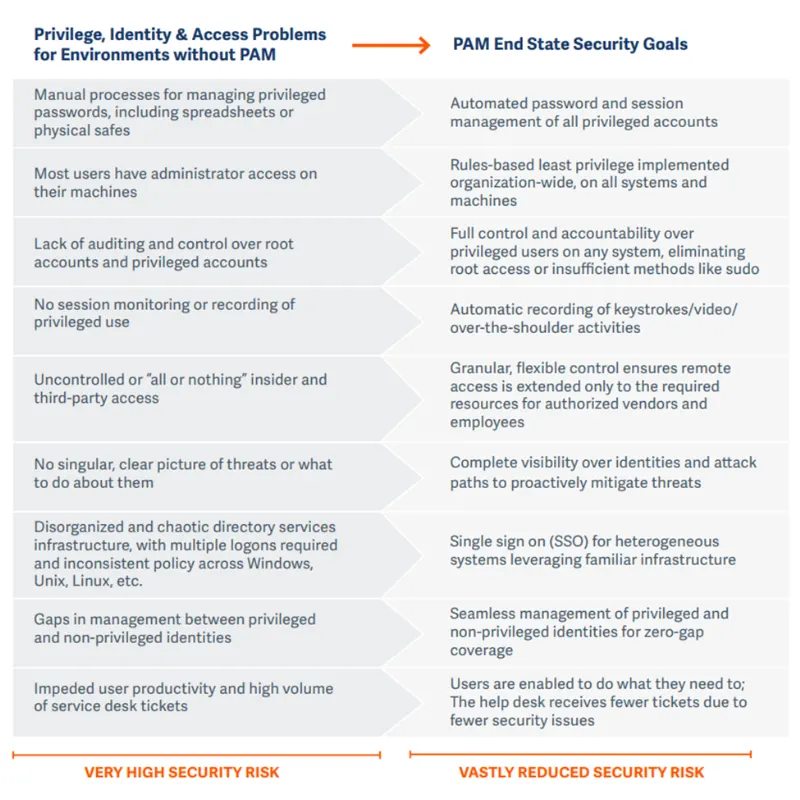
As you evaluate privilege management solutions—or any enterprise solution for that matter—we recommend assessing each through the lens of:
• Total cost of ownership: Does it result in time-savings (such as replacing manual processes with automation) and allow you to re-deploy resources for other initiatives? What are the direct and indirect costs to support the solution over its lifetime in your environment?
• Time-to-value: How soon will it help you measurably improve security controls and dial down risk? How soon will you realize a positive business impact (freeing up time for end-users, streamlining processes, enabling the organization to confidently embrace new technologies and business initiatives)? How long will it take to achieve your end-state goals with the solution? What are the chances/risks of it ending up as shelfware?
• Scalability: What are your needs around scale? A solution could meet some of your needs around scale, but not all of them. For example, in evaluating privileged account and session management (PASM) solutions, your needs for scale around managing privileged user passwords might be different than your needs for managing SSH keys, DevOps secrets, application credentials, service accounts, or machine passwords. Some solutions will only be able to manage one of these types of passwords in the first place. Other solutions might offer broader coverage across diverse password types and meet your needs for scale around some of these capabilities (i.e. privileged user password management), but fail to meet your scalability needs around other capabilities (i.e. SSH key management, application password management, DevOps secrets, etc.). On top of this, if auditing all privileged activity is important to you (it should be), few PASM solutions can scale to manage and monitor thousands of concurrent sessions. So, it’s important to understand the various facets of your scalability needs upfront.
• Integrations/Interoperability: How does it integrate with the rest of your security ecosystem (IAM, service desk, SIEM, SOAR, etc.)? Does it help you make better decisions on risk? If it only works well as a standalone/point solution, it’s probably only a stopgap versus a long-term solution. On the other hand, if the solution has synergies with your existing security solutions, it will also help you maximize existing investments.
• Longetivity: Will the solution vendor grow with you or even pull you towards growth through security enablement? Is the vendor resourced to evolve capabilities and deepen feature-richness to meet the PAM use cases of tomorrow?
The Buyer’s Guide will help you gain perspective and context on how to quantify each of these values.
What Else will this Guide Cover?
• A 6-step approach to holistic privileged access management and improved identity security
• The key PAM capabilities you should prioritize to reduce security risks, improve operational performance, and simplify your path to achieving compliance initiatives
• PAM considerations for specialized use cases (OT security, DevOps, robotic process automation, zero trust, cyber insurance qualification, and more)
• 7 differentiators that make BeyondTrust stand out from other vendors in the space—including a section on how we have genuinely revolutionized the PAM space
• Your own PAM Buyer's Guide checklist template to help you identify your needs and assess and compare vendors
Each of the 6 steps in the guide represents a core area, that when implemented, enhances an enterprise's control and accountability over the identities, accounts, assets, users, systems, and activity that comprise its privilege environment, while eliminating and mitigating many threat vectors. Some organizations may try to implement many or all of these areas at once or within a short timeframe, but the more common approach is to phase in controls for one or a few areas of PAM at a time.
Ready for the Next Steps in Your PAM Journey?
To learn more about how privileged access management (PAM) can provide identity and access security to protect your organization in today's threat landscape, join our webinar. And don't forget to grab your copy of the Buyer's Guide for Complete Privileged Access Management (PAM) now.