

Acronym Overload: Cybersecurity's First Game to Tackle Acronym Sprawl


Acronym Overload: Cybersecurity's First Game to Tackle Acronym Sprawl
TL;DR: We built a game to fight one of the most overlooked risks in cybersecurity: Acronym Overload. It’s fun, fast, and will test whether you really know your security acronyms. Play the Game Now!
Cybersecurity’s Most Underrated Risk? Acronyms.
CISOs today are battling ransomware, sophisticated phising attacks, and insider threats. But there’s another persistent, oft-overlooked, low-grade risk that undermines security teams everywhere—we’re talking about acronym confusion.
When your security stack is a soup of terms like IAM, JIT, UAR, EDR, and more, things get lost in translation. And too add further confusion, some acronyms stand for multiple, different widely used technologies or concepts. A junior analyst may interpret one thing. An engineer may assume another. The result? Miscommunication, misalignment, and real, exploitable gaps in security posture.
In this blog, I unpack the hidden dangers of acronym overload in cybersecurity and highlight how a fun, interactive acronym game can help your team cut through the jargon to achieve better cybersecurity outcomes.
Decoding the Acronym Problem in Cybersecurity
The world of cybersecurity is swimming in terminology. One community-sourced list on Github now tracks over 300 cybersecurity-related acronyms, and that number doesn’t take into consideration product and product feature acronyms, internal shorthand, and company-specific jargon that piles up inside organizations. Even BeyondTrust (BT) does it. Here are just a few of the acronyms we throw around daily:
RS - Remote Support
PRA – Privileged Remote Access
PS / PWS – Password Safe
EPM – Endpoint Privilege Management
ADB – Active Directory Bridge
ISRA – Identity Security Risk Assessment
The communication barrier that stems from this sprawling list of letters drove the frustration that prompted Elon Musk’s now-famous 2010 email to his team at SpaceX, bluntly titled “Acronyms Seriously Suck”. He argued that forcing people to memorize a glossary just to function is a “significant impediment to communication”. His directive was simple: use plain language. He further stated that the “key test for an acronym is to ask whether it helps or hurts communication”.
Securing a complex digital enterprise demands the same level of clarity. When security feels like an exclusive club with its own secret language, it prevents the organization-wide adoption of best practices. How can you defend against threats if your team can’t even agree on what they’re called?

The High Cost of a Communication Breakdown
Project Management Institute (PMI)’s Pulse of the Profession™ report found that 56% of the money spent on projects is at risk due to ineffective communications. When applied to a multi-million-dollar security budget, the financial risk is staggering. Communication risks can be translated into daily security operational risks in a number of ways:
A request to “deprovision JIT access” could be misinterpreted, leaving a standing privilege active.
An alert from your SIEM might be ignored if the on-call analyst doesn’t recognize the terminology.
During a critical incident, time is wasted defining terms instead of executing the response plan.
At BeyondTrust, we think it’s time to change that. So, we built a game.
Introducing: Acronym Overload
Acronym Overload is a first-of-its-kind security mini-game designed to test and sharpen your knowledge of cybersecurity acronyms in real time. It’s fast-paced, challenging, and surprisingly addictive.
The premise is simple:
Catch the real security acronyms (like PAM, SIEM, MFA)
Dodge the fake ones (like YAWN, BLOB, SNEE)
Lose a life every time you miss or mess up
Survive as long as you can
Why We Built an Acronym Busting Game
At BeyondTrust, we live and breathe identity and access security, but even we’ve seen the confusion that acronyms can create during onboarding, product training, and customer calls:
Teams use Privileged Access Management (PAM) and Identity Governance and Administration (IGA) interchangeably.
Just-in-Time (JIT) access is misunderstood as a replacement for Zero Standing Privilege.
“Least privilege” becomes a vague buzzword instead of an enforced, measurable policy.
Acronym Overload is our way of raising awareness and getting people talking, learning, and hopefully laughing a little. It’s also a reflection of one of our core missions: to cut through the noise.
Figure 2: In today’s distributed environments, there are more applications, roles, entitlements, and acronyms than ever. BeyondTrust is working hard to simplify that landscape, replacing complexity with visibility and clarity (instead of just adding to the acronym soup) so teams can align, communicate, and secure privileges and potential escalation pathways.
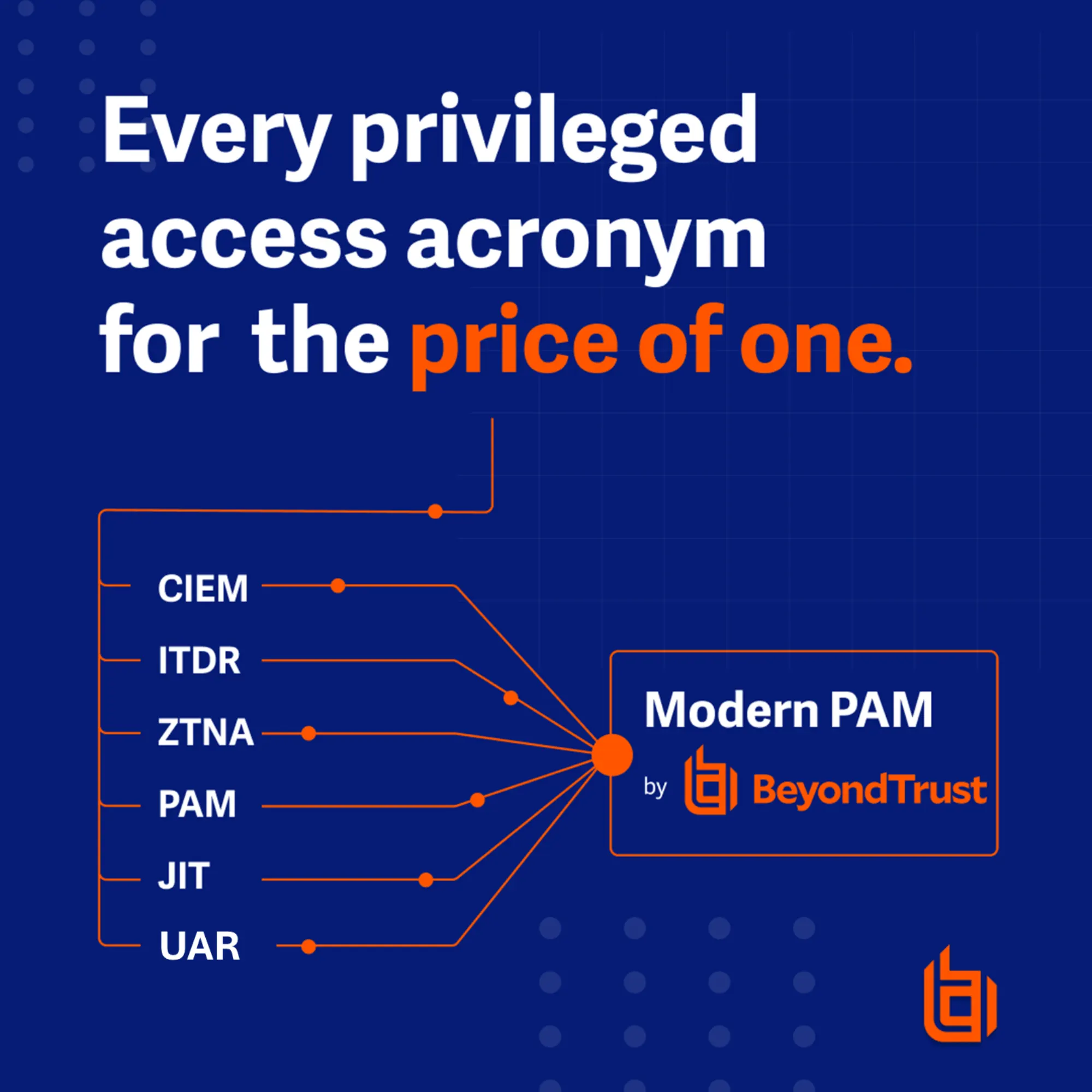
In a market crowded with acronym-heavy products—CIEM, JIT, ITDR, ZTNA, UAR, and PAM—we believe security teams need clarity and integration, not complexity. That’s the foundation of our modern PAM approach. Instead of selling six separate solutions, we’ve built one unified platform that covers the capabilities these acronyms represent, without requiring you to learn a new alphabet.
Ready to Test Your Skills?
If you’ve ever sat in a meeting nodding along while secretly Googling acronyms under the table, this game is for you. Tag your score. Share your thoughts. Challenge your coworkers. And the next time someone casually drops “ZTA with JIT via ABAC” into a sentence, you’ll be ready.
Want to boost your score with some in-game help? Our Cybersecurity Glossary can give you deeper insights into the acronyms you’ll be battling.
About the Author
Dean Pe'er
Dean has eight years of cybersecurity marketing experience across startups, focused on OT security, red‑team services, cloud security, and identity security. He joined BeyondTrust through the acquisition of Entitle, where he was the sole marketer. Dean holds an M.Sc. in Industrial Engineering.