

Alert icon Keyboard navigation enabled.
Alert icon TAB or Shift+TAB to navigate across. Down ↓ to open menu. ESC to close menu.
Alert icon Down ↓ to select section. Right → to activate. Up ↑ / Down ↓ / Tab to traverse all. ESC to exit.
BeyondTrust
Skip to content Use space or enter to skip.

What can we help you find today?

Instant Results
  • Website Results
  • Technical Documentation

Filter Options

Focus your search

Filtering by

Your recent searches:

Contact Us Chat with Sales Get Support
  • English
  • Deutsch
  • français
  • español
  • 한국어
  • português
  • Home
  • Resources
  • Blog
  • Zero Trust and Passwordless Authentication current page
Link copied

Zero Trust and Passwordless Authentication

May 2, 2022
Author:
Raef Meeuwisse 2020 Headshot
​Raef Meeuwisse
Cybersecurity Expert and Author
Blog banner default
Zero Trust and Passwordless Authentication
Raef Meeuwisse 2020 Headshot
​Raef Meeuwisse
Cybersecurity Expert and Author

Cybersecurity is not an industry that is synonymous with fashion. We have never had an iPhone moment before; that point when a smart, sparkly new technology appears that is so useful and usable that it goes from nowhere to becoming the de rigueur standard in the space of just a few years.

Most of what hits the press about cybersecurity is the – Who just got their brand annihilated by a very public mega-breach? Or, What snarky new trend are the cybercriminals leveraging?

It’s nice to have some good news for a change.

The good news here is: Passwords are dying out.

No, really they are.

Yes, there will still be some passwords around BUT due to the relatively recent development of certain new security standards and protocols – organizations are now able to move to a passwordless model. And as it turns out – this passwordless model has quite a few substantial security benefits – if you put the pieces together correctly.

In my on-demand webinar Zero Trust = Zero Passwords?, we explore exactly what passwordless really means – and for good reason – because any organization retaining an ongoing reliance on passwords is rapidly marking itself out as a highly vulnerable target for cybercriminals. In other words, no organization wants to get caught out not knowing what passwordless is and what security benefits it can bring.

Perhaps it is because I started out as an auditor – but there is nothing more concerning to me (right now) than any supplier who still needs each user to authenticate with a username and password – and to do it on every session - and on top of that – has no secondary authentication either. They literally might as well paint a large bullseye over the door of their corporate headquarters – and place a brush matt in the entrance emblazoned with the words “Hackers welcome”.

In addition to the transition away from passwords, another emergent trend is towards the buzz of Zero Trust. Just what is zero trust? Does the definition depend on who you talk to? Is zero trust easy to deploy? And – does it fit with the exciting trend of going passwordless?

I have taken my experiences (good and bad) and research into zero trust and passwordless security to put together a concise explanation of these topics and how they relate to each other. I have also included some top tips – and an outline of the potential pitfalls to be aware of during deployment.

Zero Trust has become the buzzword of the moment in cybersecurity sector at the moment – but what is it really? After all - a lot of the principles (apply least privilege, trust nothing by default, …) really do not sound any different from the core security principles we are supposed to have been applying for a long time.

Join the on-demand webinar session for a fun and insightful journey into the world of zero trust and passwordless authentication. Does zero trust mean zero passwords? Check out the session to find out!
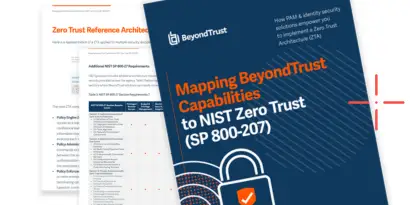
Mapping BeyondTrust Capabilities to NIST Zero Trust (SP 800-207)

Resources

Mapping BeyondTrust Capabilities to NIST Zero Trust (SP 800-207)

Passwordless Administration Explained

Blog

Passwordless Administration Explained

Latest Posts
  • The Most Common & Most Dangerous Types of Shadow IT
    Jun 5, 2026 The Most Common & Most Dangerous Types of Shadow IT
    Blog
    19m
  • 14 Password Management Best Practices
    May 28, 2026 14 Password Management Best Practices
    Blog
    12m
  • A Security Researcher’s Guide to Understanding Copilot Studio AI Agents
    May 26, 2026 A Security Researcher’s Guide to Understanding Copilot Studio AI Agents
    Blog
    3m
  • How to Secure Cloud-Native Infrastructure at Scale and Speed: A Conversation with Madhu Adireddi
    May 21, 2026 How to Secure Cloud-Native Infrastructure at Scale and Speed: A Conversation with Madhu Adireddi
    Blog
    5m
  • Cybersecurity as a Boardroom Priority for Major African TelCos
    May 12, 2026 Cybersecurity as a Boardroom Priority for Major African TelCos
    Blog
    8m
Related
  • How to simplify IT security for universities
    Oct 20, 2017 How to simplify IT security for universities
    Blog
    1m
  • Unsecure Remote Access Again Named Top Method of Compromise in 2017 Trustwave Global Security Report
    Jun 26, 2017 Unsecure Remote Access Again Named Top Method of Compromise in 2017 Trustwave Global Security Report
    Blog
    1m
Share this Article
  • Link
Stay up to Date
Get the latest news, ideas, and tactics from BeyondTrust. You may unsubscribe at any time.

Keep up with BeyondTrust

Customer Support Get Started
  • LinkedIn
  • X
  • Facebook
  • Instagram
  • Add BeyondTrust as a preferred source on Google
  • Privacy
  • Security
  • Manage Cookies
  • Do Not Sell My Data
  • WEEE Compliance

Copyright © 2003 — 2026 BeyondTrust Corporation. All rights reserved. Other trademarks identified on this page are owned by their respective owners. BeyondTrust Corporation is not a chartered bank or trust company, or depository institution. It is not authorized to accept deposits or trust accounts and is not licensed or regulated by any state or federal banking authority.

Prefers reduced motion setting detected. Animations will now be reduced as a result.