Alert icon Keyboard navigation enabled.
Alert icon TAB or Shift+TAB to navigate across. Down ↓ to open menu. ESC to close menu.
Alert icon Down ↓ to select section. Right → to activate. Up ↑ / Down ↓ / Tab to traverse all. ESC to exit.
BeyondTrust
Skip to content Use space or enter to skip.

What can we help you find today?

Instant Results
  • Website Results
  • Technical Documentation

Filter Options

Focus your search

Filtering by

Your recent searches:

Contact Us Chat with Sales Get Support
  • English
  • Deutsch
  • français
  • español
  • 한국어
  • português
  • Home
  • Resources
  • Blog
  • Australian Signals Directorate Essential Eight Explained current page
Link copied

Australian Signals Directorate Essential Eight Explained

Feb 8, 2017
Author:
Morey Haber Headshot 2024
Morey J. Haber
Chief Security Advisor
Blog banner default
Australian Signals Directorate Essential Eight Explained
Morey Haber Headshot 2024
Morey J. Haber
Chief Security Advisor

Australian Signals Directorate Essential Eight Explained

The dynamic nature of cyber security requires constant adjustments and course corrections to address the latest threats. Businesses and governments are accustomed to broad stroke changes occurring every few years, but rarely are recommendations made that are very precise to manage specific threats.

In October 2014, BeyondTrust responded to the Australian Signals Directorate (ASD) Top 4 recommendations with a blog and white paper that addressed how to mitigate the most common cyber security risks for information technology using BeyondTrust solutions. This month, the ASD has created an addendum called the Essential Eight that provides specific recommendations, on top of the Top 4, to combat modern malware, incidents, and data recovery.

The goal of addendum is to provide a practical prioritized list of guidance to manage risk and minimize the success of a breach. It complements the established 35 best practice mitigation recommendations and maturity model recommended by the ASD and inserts these new four recommendations between the Top 4 and remaining 31 recommendations.

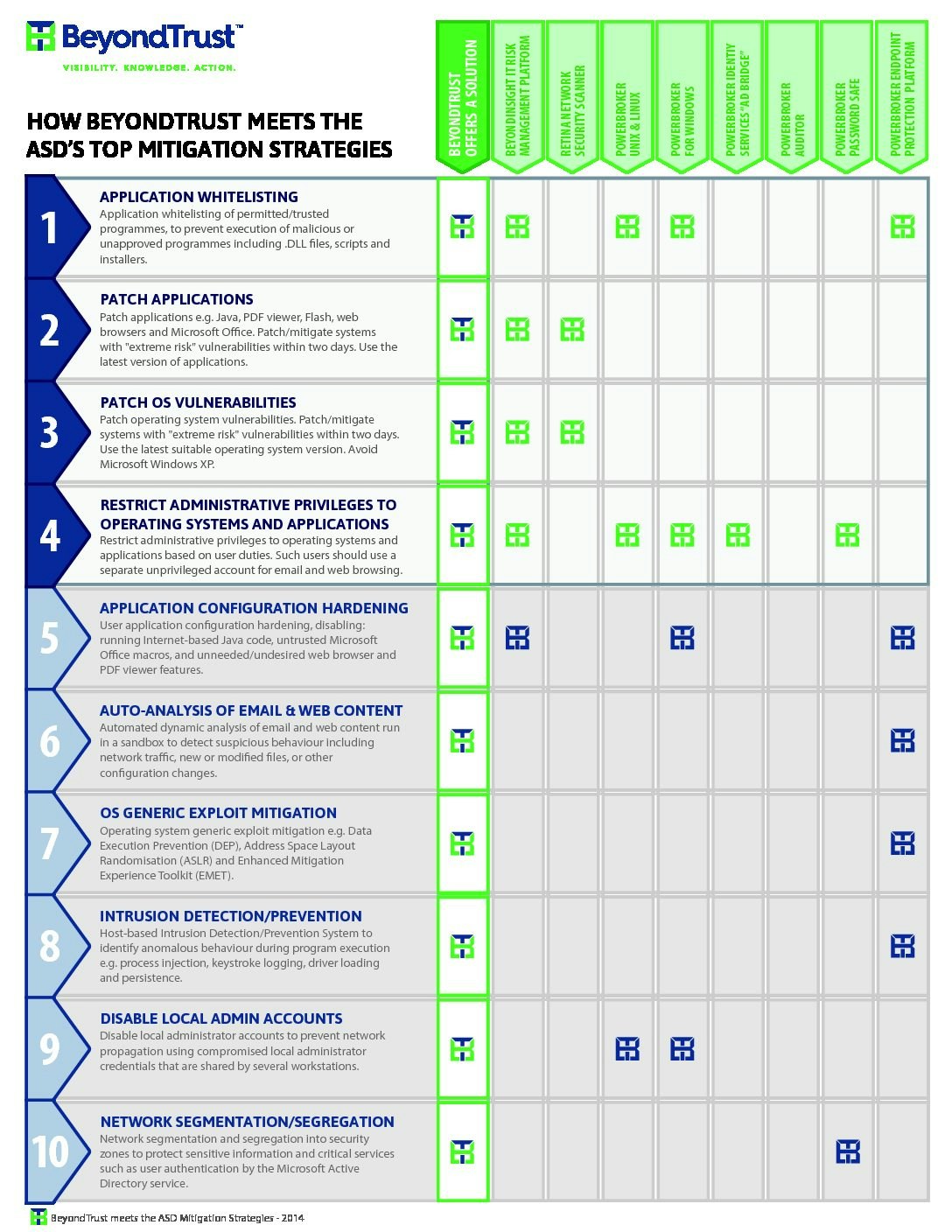
The Essential Eight is the existing Top 4, plus 4 new ASD recommendations

blog-asd-mitigation-strategies.jpg

Australian Signals Directorate Top 4 (Existing)

  1. Application allow listing of permitted/trusted programs, to prevent execution of malicious or unapproved programs including executables. Scripts, and installers.
  2. Patch applications - e.g. Java, PDF viewer, Flash, web browsers and Microsoft Office. Patch/mitigate systems with "extreme risk" vulnerabilities within two days. Use the latest version of applications.
  3. Patch operating system vulnerabilities. Patch/mitigate systems with "extreme risk" vulnerabilities within two days. Use the latest suitable operating system version. Avoid Microsoft Windows XP.
  4. Restrict administrative privileges to operating systems and applications based on user duties. Such users should use a separate unprivileged account for email and web browsing.

Essential Eight (Top 4 plus 4 New Ones)

  1. Disable untrusted Microsoft Office Macros so malware cannot run unauthorized routines.
  2. Block Web browser access to Adobe Flash, web advertisements, and untrusted Java code on the Internet. If possible, uninstall all browser plugins that are not required.
  3. Multi-factor authentication for all systems when possible to make it harder for an adversary to access a system and information
  4. Daily backup of important data securely and offline to ensure even if data is compromised, protected versions are available for recovery.

These new essential recommendations are a simple course correction for the ASD to address modern threats like ransomware and drive by web attacks. BeyondTrust can help assess systems that may not be compliant to these recommendations and aid with privileged access management to secure assets and data with existing (or new) multi-factor authentication initiatives. For more information, contacts us today.

Latest Posts
  • Hooked on Identity: Abusing SAML Assertion Inline Hooks in Okta
    Jun 9, 2026 Hooked on Identity: Abusing SAML Assertion Inline Hooks in Okta
    Blog
    6m
  • Joining Project Glasswing: Securing the Privilege Backbone of the AI Era
    Jun 8, 2026 Joining Project Glasswing: Securing the Privilege Backbone of the AI Era
    Blog
    5m
  • The Most Common & Most Dangerous Types of Shadow IT
    Jun 5, 2026 The Most Common & Most Dangerous Types of Shadow IT
    Blog
    19m
  • 14 Password Management Best Practices
    May 28, 2026 14 Password Management Best Practices
    Blog
    12m
  • A Security Researcher’s Guide to Understanding Copilot Studio AI Agents
    May 26, 2026 A Security Researcher’s Guide to Understanding Copilot Studio AI Agents
    Blog
    3m
Related
  • Cyber Security Challenges for Small to Medium Size Businesses
    Jan 25, 2017 Cyber Security Challenges for Small to Medium Size Businesses
    Blog
    1m
  • Cloud Integration: Okta + PowerBroker for Unix & Linux for Authorization and Command Control
    Aug 2, 2018 Cloud Integration: Okta + PowerBroker for Unix & Linux for Authorization and Command Control
    Blog
    1m
Share this Article
  • Link
Stay up to Date
Get the latest news, ideas, and tactics from BeyondTrust. You may unsubscribe at any time.

Keep up with BeyondTrust

Customer Support Get Started
  • LinkedIn
  • X
  • Facebook
  • Instagram
  • Add BeyondTrust as a preferred source on Google
  • Privacy
  • Security
  • Manage Cookies
  • Do Not Sell My Data
  • WEEE Compliance

Copyright © 2003 — 2026 BeyondTrust Corporation. All rights reserved. Other trademarks identified on this page are owned by their respective owners. BeyondTrust Corporation is not a chartered bank or trust company, or depository institution. It is not authorized to accept deposits or trust accounts and is not licensed or regulated by any state or federal banking authority.

Prefers reduced motion setting detected. Animations will now be reduced as a result.