
This report notes a shift happening now: stealing identities is becoming easier than exploiting a vulnerability. As a consequence, identity-based attacks will likely become even more common in the near future.
Paula Januszkiewicz, CEO, CQURE


The latest Microsoft Vulnerabilities data, analyzed
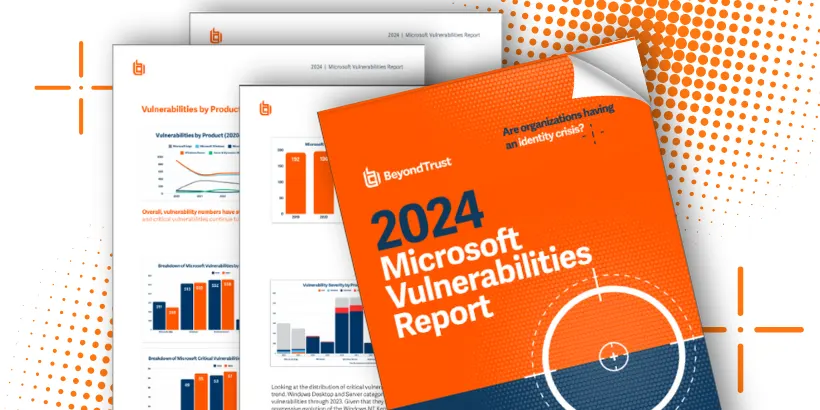
Since the annually-published BeyondTrust Microsoft Vulnerabilities Report debuted in 2013, it has garnered over 16,000 downloads and helped thousands of users leverage its detailed data analysis and expert findings to improve their cyber defenses.
1,228 total vulnerabilities, dropping slightly (by 5%) from 1,292 in 2022, but total vulnerabilities have held firm near their all-time highs, remaining between 1,200 and 1,300 for the past four years (since 2020).
For the fourth year in a row, Elevation of Privilege was the #1 vulnerability category.
The total number of critical vulnerabilities continues its downward trend, but slowly. Critical vulnerabilities dropped by 6% to 84 in 2023 (5 less than 2022).
After Microsoft Azure & Dynamics 365 vulnerabilities skyrocketed in 2022, they almost halved in 2023 – down from 114 to 63.
Read the full report for a deeper dive into these findings so you can better understand, identify, and address the risks within the Microsoft ecosystem.
This report notes a shift happening now: stealing identities is becoming easier than exploiting a vulnerability. As a consequence, identity-based attacks will likely become even more common in the near future.
Paula Januszkiewicz, CEO, CQURE
Vulnerabilities Data Deep-Dive
Find out how vulnerabilities have trended between categories (including Elevation of Privilege and Remote Code Execution) and between Microsoft products and, more importantly, why. The report also spotlights some of the most significant CVEs of 2023 (9.0+ CVSS severity scores), breaks down how they are leveraged by attackers, and explains how they can be mitigated.
A Breakdown of the Vulnerability Snowball Effect
Learn why the vulnerability count can start to snowball—even after a vulnerability is found and patched.
Expert Opinions and Advice
Hear from notable industry figures, such as Paula Januszkiewicz, CEO, CQURE; David Morimanno, Director of Identity & Access Management Technologies, Integral Partners, a Xalient Company; Greg van der Gaast, Managing Director, Sequoia Consulting; Terry Cutler, Ethical Hacker & Founder, Cyology Lab; Sami Laiho, Windows OS MVP Chief Research Officer / Founder, Truesec Finland; Eliza-May Austin, CEO, th4ts3cur1ty.company; Dr. Jessica Barker, Co-Founder, Cygenta; Marc Maiffret, Chief Technology Officer, BeyondTrust.
Are Organizations Having an Identity Crisis?
Increasingly, attackers are re-focusing their efforts on exploiting identities rather than Microsoft software vulnerabilities. Learn from real-life examples of the growing challenges organizations face around managing identities and identity security.
How to Identify an Identity Crisis in Your Microsoft Ecosystem
Learn what an identity crisis in your Microsoft ecosystem looks like, with insights drawn from the new Attack Vectors book. In a world where it is easier to log in than hack in, identity has become the new perimeter.
Since privileges are what threat actors want, our main job should be to make sure they don’t get them.
Sam Laiho, WIndows OS MVP, Chief Research Officer / Founder
Timely patching is an important way to minimize the chance of a vulnerability-related breach. Yet, with this strategy alone, organizations will still be at risk of zero-day exploits. In addition, patching vulnerabilities is not always practical or desired by an organization. That’s why it’s crucial to have proactive security defenses, such as a least privilege posture, in place.
This proactive approach can provide highly effective protection, even in the absence of patching. Removing local admin rights, and controlling execution, has historically mitigated 75% of Microsoft’s critical vulnerabilities.
BeyondTrust combines complete privileged access management (PAM), along with CIEM and ITDR capabilities, to mitigate Microsoft vulnerabilities and protect the entire identity infrastructure—from Active Directory to Entra ID and beyond.