Alert icon Keyboard navigation enabled.
Alert icon TAB or Shift+TAB to navigate across. Down ↓ to open menu. ESC to close menu.
Alert icon Down ↓ to select section. Right → to activate. Up ↑ / Down ↓ / Tab to traverse all. ESC to exit.
BeyondTrust
Skip to content Use space or enter to skip.

What can we help you find today?

Instant Results
  • Website Results
  • Technical Documentation

Filter Options

Focus your search

Filtering by

Your recent searches:

Contact Us Chat with Sales Get Support
  • English
  • Deutsch
  • français
  • español
  • 한국어
  • português
  • Home
  • Resources
  • A Least Privilege Strategy Guide to Strengthen Security for Public Sector Agencies current page
Link copied

A Least Privilege Strategy Guide to Strengthen Security for Public Sector Agencies

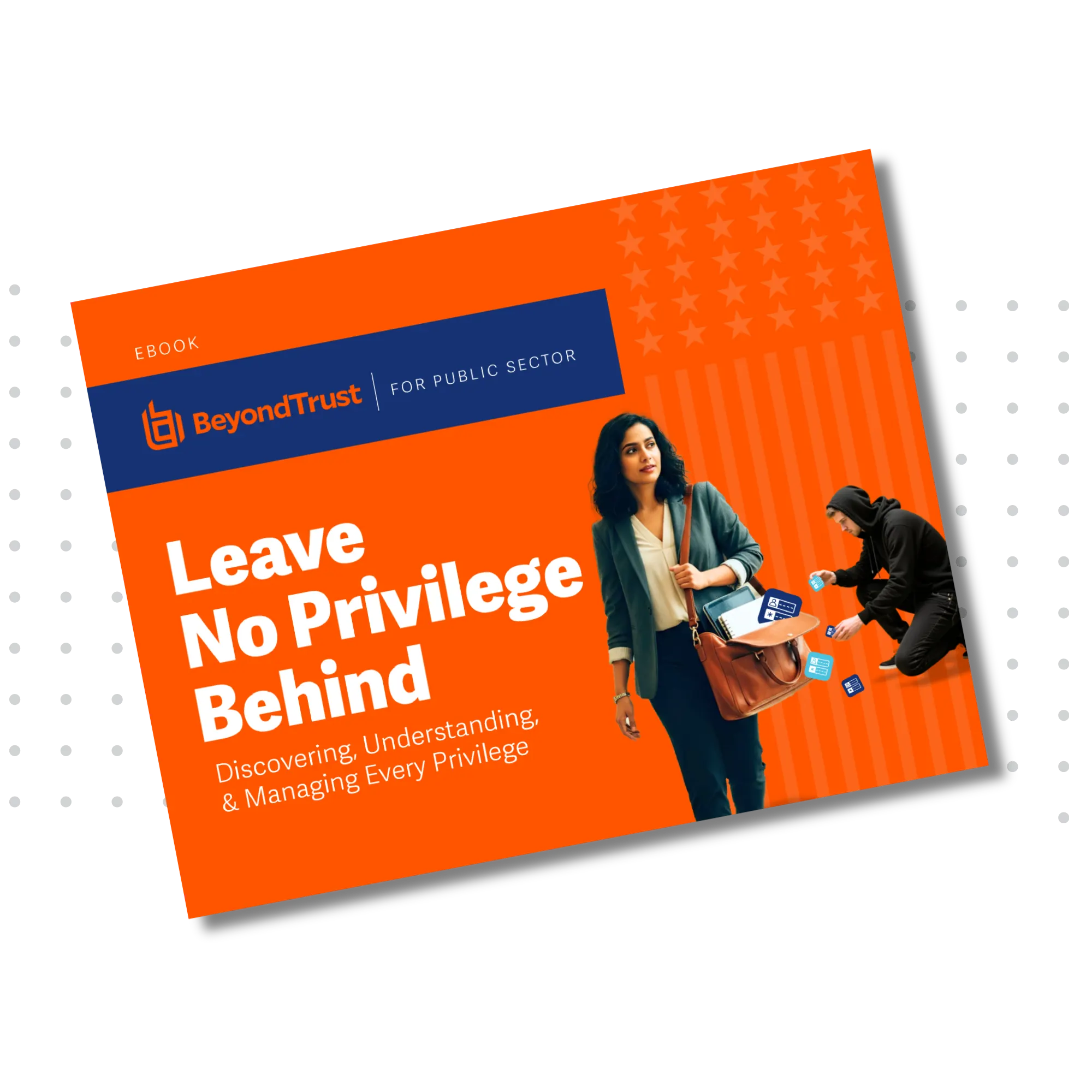
Resource Card Leave No Privilege Behind
A Least Privilege Strategy Guide to Strengthen Security for Public Sector Agencies

Get Instant Access to this Content

Learn more about how to secure your business from threats in places you didn't even know existed.

Leave No Privilege Behind & Enable Zero Trust

White chain icon to symbolize the ability to copy a link
Link copied
Check mark to visually show text has been copied

Almost every modern cyberattack—ransomware, insider threats, supply chain compromises, nation-state intrusions, etc.—shares a common theme: privileged access is needed to move laterally, maintain persistence, and / or gain a deeper foothold into environments.

Privilege is the key exposure point that gives attackers power. Any unmanaged, excessive, or risky privilege or entitlement can become a means for threat actors to launch or expand their attacks.

Which privileges do organizations commonly “leave behind”, undermining security and uptime? Examples include:

  • Standing or temporary accounts
  • Active or dormant entitlements
  • Shadow identities (unregistered SaaS accounts, self-service cloud access)
  • Shared accounts (admin, root, superuser)
  • Service accounts (domain-joined, database, application / web services)
  • Cloud service principals (AWS IAM roles, Azure, GCP)
  • AI agents (AI assistance, agentic, and model-to-model)
  • Machine-to-machine communications (Kubernetes, message brokers)
  • And many others

“Managing privileges across your identity estate requires going beyond surface-level account inventories.”

—Kevin E. Greene, Public Sector Chief Cybersecurity Technologist, BeyondTrust

What is a Leave No Privilege Behind Mindset?

White chain icon to symbolize the ability to copy a link
Link copied
Check mark to visually show text has been copied

Leave No Privilege Behind is a strategic approach to privilege-centric identity security that CISOs, infrastructure, and security teams can take to ensure every privilege—human, machine, and AI agent—is discovered, governed, right-sized, and continuously monitored and audited. It helps drive and operationalize a full-stack approach to least privilege.

While this ebook is written for a public sector audience, its insights and practices apply to organizations of any industry that want to better manage their identity attack surface and reduce enterprise cyber risks.

This mindset empowers public sector / government agencies to meet critical cybersecurity goals, such as:

  • Operationalizing Zero Trust: Managing every privilege via the right identity intelligence informs organizations about where and how to harden their zero trust architecture.
  • Establishing AI Security: Managing every privilege enables public sector organizations to better secure agentic AI identities.

"Leave No Privilege Behind is a strategic approach to identity security that CISOs, infrastructure, and security teams can take to ensure every privilege—human, machine, or AI agent—is discovered, governed, minimized, and continuously validated so threat actors cannot use them to escalate, move laterally, or gain persistence."

—Kevin E. Greene, Public Sector Chief Cybersecurity Technologist, BeyondTrust

Next Steps to Strengthen Your Security via Least Privilege and Leave No Privilege Behind

White chain icon to symbolize the ability to copy a link
Link copied
Check mark to visually show text has been copied

Download the full ebook to learn more about how to Leave No Privilege Behind—whether human, machine, or AI agent—within your agency.

You’ll get tactical steps for implementing least privilege access and zero trust security principles throughout your environment, including:

  • Seeing beyond surface-level inventories with the concepts of True Privilege™ and Paths to Privilege™
  • Collecting the right identity intelligence, especially continuous visibility and actionable telemetry, to inform privilege management across domains
  • 6 steps to preventing privilege gaps
  • 10 key takeaways for actionable next steps

Plus, discover how you can actualize a Leave No Privilege Behind mindset with BeyondTrust.

FAQs

White chain icon to symbolize the ability to copy a link
Link copied
Check mark to visually show text has been copied

Privilege-centric identity security is important for government and public sector organizations because these groups are often favored targets for attackers. Prioritizing privileged access management (PAM) and other privilege-centric identity security controls ensures agencies gain comprehensive visibility and control over privileges and escalation paths. This also encompasses managing privileged accounts, eliminating standing access, enforcing least privilege, and continuously validating how privileges are being used.

Zero trust is a cybersecurity strategy that many government agencies adopt to strengthen cybersecurity and comply with numerous compliance frameworks. It assumes no user, device, workload, or identity should be inherently trusted. Zero trust requires verifying every identity and every access request based on context, privilege level, and risk. A few foundational zero trust controls for public sector organizations to consider include:

  • JEP (Just Enough Privilege): only getting the privileges needed to do a task or activity
  • JEA (Just Enough Access): restricting which actions an identity can take
  • JIT (Just-in-Time) Access: only elevating privileges for a short, approved window
Resource Card Leave No Privilege Behind
Research
A Least Privilege Strategy Guide to Strengthen Security for Public Sector Agencies
Share this Article
  • Link

Keep up with BeyondTrust

Customer Support Get Started
  • LinkedIn
  • X
  • Facebook
  • Instagram
  • Add BeyondTrust as a preferred source on Google
  • Privacy
  • Security
  • Manage Cookies
  • Do Not Sell My Data
  • WEEE Compliance

Copyright © 2003 — 2026 BeyondTrust Corporation. All rights reserved. Other trademarks identified on this page are owned by their respective owners. BeyondTrust Corporation is not a chartered bank or trust company, or depository institution. It is not authorized to accept deposits or trust accounts and is not licensed or regulated by any state or federal banking authority.

Prefers reduced motion setting detected. Animations will now be reduced as a result.
MS Vulns Report 2026 orange background 1

New: 2026 Microsoft Vulnerabilities Report

Access the report for expert analysis of Microsoft's vulnerability and security landscape, breaking down key trends, security shifts, emerging risks—and what it all means for you.

Get the Report

New: 2026 Microsoft Vulnerabilities Report: Access the report for expert analysis of Microsoft's vulnerability and security landscape, breaking down key trends, security shifts, emerging risks—and what it all means for you.

Get the Report