

Multicloud Security: More Clouds, More Problems


Multicloud Security: More Clouds, More Problems
Today, cloud vendor lock-in fears of the past seem overblown. Instead of choosing one cloud or another, organizations are simply choosing both, or to be more precise, many! Most organizations aren’t merely in the cloud—they’re in many clouds (PaaS, IaaS), and their end users regularly consume dozens, or even hundreds, of different SaaS applications. A McAfee study published a couple years back reported the average organization used 1,935 cloud services. And that number has almost certainly ballooned further since then.
Over the past year, the great cloud migration has enabled the successes of increased remote working and is propelling the acceleration of digital transformation initiatives. Yet, more clouds can mean more security and operational challenges. Siloed identity stores (i.e. Azure ID), native, but incomplete toolsets, and conflicting shared responsibility models between cloud providers—along with all the fundamental cloud security challenges—is creating a fertile atmosphere for threat actors. Additionally, most companies are not 100% cloud – they operate with a hybrid model that includes an on-premises infrastructure, often based on legacy technology.
Inadequate privileged access security controls—often involving credentials, excessive privileged access, or misconfigurations—play a role in most breaches today across both cloud and on-premises environments. The scale of managing the exploding universe of privileges requires an integrated, universal approach, rather than relying on a stack of niche tools, each only helping to manage a slice of the privilege problem. This is especially true when the elasticity of the cloud allows for rapid changes that even traditional tools for management and governance may miss.
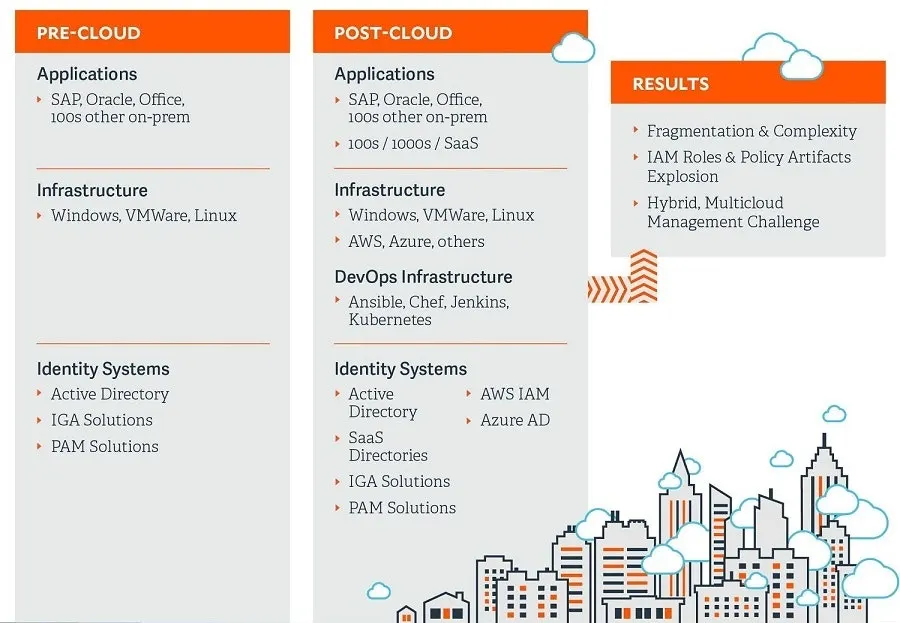
Many organizations already run at high risk from over-privileged IT administrators and power users. As they migrate more workloads to the cloud, the on-premises complexity doesn’t vanish. Instead, they tend to end up with the hybrid, multicloud management challenge represented in this figure:
Lean into Identity-Centric Security to Address the Most Critical Multicloud & Hybrid IT Security Gaps
As environments have trended toward increasing decentralization, identity has become the strongest foundation for security. The identity challenge is the most important security problem for organizations to solve for across cloud and on-premises environments. And, no identities are more critical to protect than privileged identities—whether associated with humans or machines, employees or vendors, and whether they are persistent or ephemeral. Solving for the multicloud / hybrid identity and privilege challenges is best accomplished by standardizing the management and security controls across the entire IT ecosystem.
Ultimately, your privileged access management strategy should ensure every privileged account, session, and asset is secured, managed, and monitored across your entire cloud and hybrid infrastructure. BeyondTrust Privileged Access Management (PAM) solutions protect your entire multicloud and hybrid environment via ouruniversal privilege management model by:
Continuously discovering and onboarding privileged accounts and cloud instances
Enforcing credential security best practices across every human and non-human account, including implementing zero trust architectures
Reducing the number of users with privileged access
Restricting the privileges any user, application, service, or asset has for access and automation
Preventing and mitigating human-based errors in privileged access
Condensing the window of time during which privileges can be executed, and thereby abused, by applying the principle of just-in-time access
Enforcing segmentation of the cloud environment and securing/proxying remote access to cloud management consoles / control planes and to computing resources
Robustly managing and monitoring every privileged session and providing certification for regulatory compliance
Providing a single, centralized platform for all privilege management activity that is architected to integrate with the rest of your security and information technology ecosystem
For a deeper dive on understanding and addressing the most pressing multicloud security risks and challenges, download our new Guide to Multicloud Privilege Management to learn:
Access management gaps and privilege risk in cloud / multicloud environments
Best practices for securing privileged accounts and access for IaaS, PaaS, and SaaS
How BeyondTrust solutions protect a variety of deployment environments—cloud, hybrid, and multicloud
How BeyondTrust PAM solutions help address 10 of the "Egregious 11" top cloud security threats, as identified by the Cloud Security Alliance (CSA)