

Channel Predictions for 2025 and Beyond: The BeyondTrust Edition


Channel Predictions for 2025 and Beyond: The BeyondTrust Edition
In this edition of our annual channel predictions, we recap how last year's predictions played out through 2024, and provide our top prognostications for 2025.
Predicting the biggest trends to impact channel in 2025
While 2023 presented a year of opportunity for channels and alliances, 2024 has offered a year of challenges. Successfully merging channels and alliances into an orchestrated partner ecosystem is not an easy task. Now mix in this year’s latest challenges: high interest rates, higher inflation, massive tech layoffs, and market uncertainty slowing down sales cycles and growth. It’s not been an easy year for sales or partner ecosystem leaders.
Yet this is no time to go wobbly, as Margaret Thatcher once famously said to George Bush. There are huge rewards for the bold and courageous, as I’ll layout in my 2025 predictions. But first, let’s look at how my 2024 predictions are panning out.
Recapping BeyondTrust’s 2024 channel predictions
1. Partner success gains a seat at the customer success table
Conversations around partner success are increasing with the recognition that Partner Success drives Customer Success. This was a big theme at the ASAP (Association of Strategic Alliance Professionals) Global Alliance Summit I attended in April. It’s also been a topic on my podcast, where I learned how Barracuda revamped their partner program to launch a Partner Success Program designed around shared success with all partner types.
I’m also hearing more and more about vendors who are hiring partner success managers and tracking customers’ NPS (Net Promoter Scores) for partner delivery—like we’re doing here at BeyondTrust. What we still need to see is a greater merging of Partner and Customer Success teams and technology.
2. SaaS business metrics replace channel metrics for measuring partner ROI
Measuring partner ecosystem ROI is one of the top challenges for partner leaders. It’s been a common topic at partner conferences, including Partnership Leaders and ImpartnerCon, where Impartner’s COO, Brad Pace, gave a presentation on Mastering Partner Program ROI.
While SaaS metrics are a great way to measure the impact of the ecosystem, many companies who have transitioned from perpetual to SaaS models aren’t set up yet to measure common SaaS metrics, like CLTV (Customer Lifetime Value) and CAC (Customer Acquisition Cost). We are seeing, however, improvements in the ability to track other partner metrics besides partner originated pipeline and ACV—things like multi-partner influence and partner success via NPS scores.
It's also helpful to look at the correlation of ecosystem involvement to other business metrics. By doing this at BeyondTrust, we saw how true co-selling and partner delivery are tightly related to improvements in both partner-originated business and overall quota attainment.
3. AI accelerates the growth of partner ecosystems
Generative AI is starting to impact the partner ecosystem. Gen AI is now appearing in channel technologies, increasing the productivity of partner managers, and helping partner marketing managers develop new content faster.
We’re also seeing AI impact partner programs. Microsoft launched their AI Partner Program to help partners capitalize on the economic opportunities of Microsoft AI. Veeva Systems rolled out their AI Partner Program to enable partners to develop and deliver innovative GenAI solutions on their platform.
It’s nice to see we’re moving from hype to actual value-add. While security concerns remain, we’ll no doubt see a lot more advances in the use of AI in the coming year. Leaders should make sure, though, that team members don’t lose the ability to learn and create through an over-dependence on AI.
New channel predictions for 2025+
Building a world-class partner ecosystem gets harder in 2025, not easier
Partner technology firm Workspan published an Ecosystem Maturity Model that I have been using to plot the course and track the progress on BeyondTrust’s partner ecosystem journey. The model has 5 stages, starting with the Pre-Idea stage and ending in the World-Class stage. At this highest level, you have multiple ecosystems operating in parallel, with full flywheel adoption across all departments driving continuous innovation and growth.
Advancing along the maturity model to the world-class stage requires 100% commitment by executive leadership and 100% alignment across all departments, as well as the systems, products, and services to support the ecosystem. Gaining that commitment and alignment is getting harder due to the economic pressure and market challenges companies are facing. Investing in and implementing the processes and systems to support the ecosystem will also be difficult due to competing priorities as companies seek new ways to compete and grow.
Timid companies revert to old channel strategies under economic pressures
Economic pressures are driving large scale layoff announcements from many technology companies, cutting across all functional areas. Facing longer sales cycles and declining sales, some companies will pull back from their partner ecosystem strategy and revert to the old transactional channel model. Some will shrink or even disband their entire partner team.
These actions are a big mistake because they ignore the fundamental changes in buyer behavior that necessitate a partner ecosystem strategy to survive. What’s not changing in 2025 is the tech buyer behavior of having dozens of points of contact along the buyer journey. Those points of contact are very often with the partner community. Buyers will increasingly depend on implementing multiple vendors’ products to solve their business problems. This requires tight technology alliance integrations and fully enabled service delivery partners.
The companies who shrinking away from an ecosystem strategy will find themselves in an even worse financial condition.
Courageous companies hold steady on their ecosystem strategy
Forward-thinking leaders understand that partner ecosystems and ecosystem-led strategies are essential to innovation, growth, and resilience. These leaders will stand firm on their commitment to the success of their partner ecosystem and reap the rewards. But it won’t be easy. Just like the move from perpetual to SaaS, converting from a transactional channel to an ecosystem strategy requires companies to swallow the fish.
“Swallow the fish” was the term coined by the Technology & Services Industry Association (TSIA). TSIA is a SaaS research and advisory firm who were the authors of the revolutionary LAER (Land, Adopt, Expand and Renew) engagement model. Their fish model describes the period of increased costs and reduced revenues that companies must swallow before coming out the other side to enjoy faster revenue growth and lower labor costs
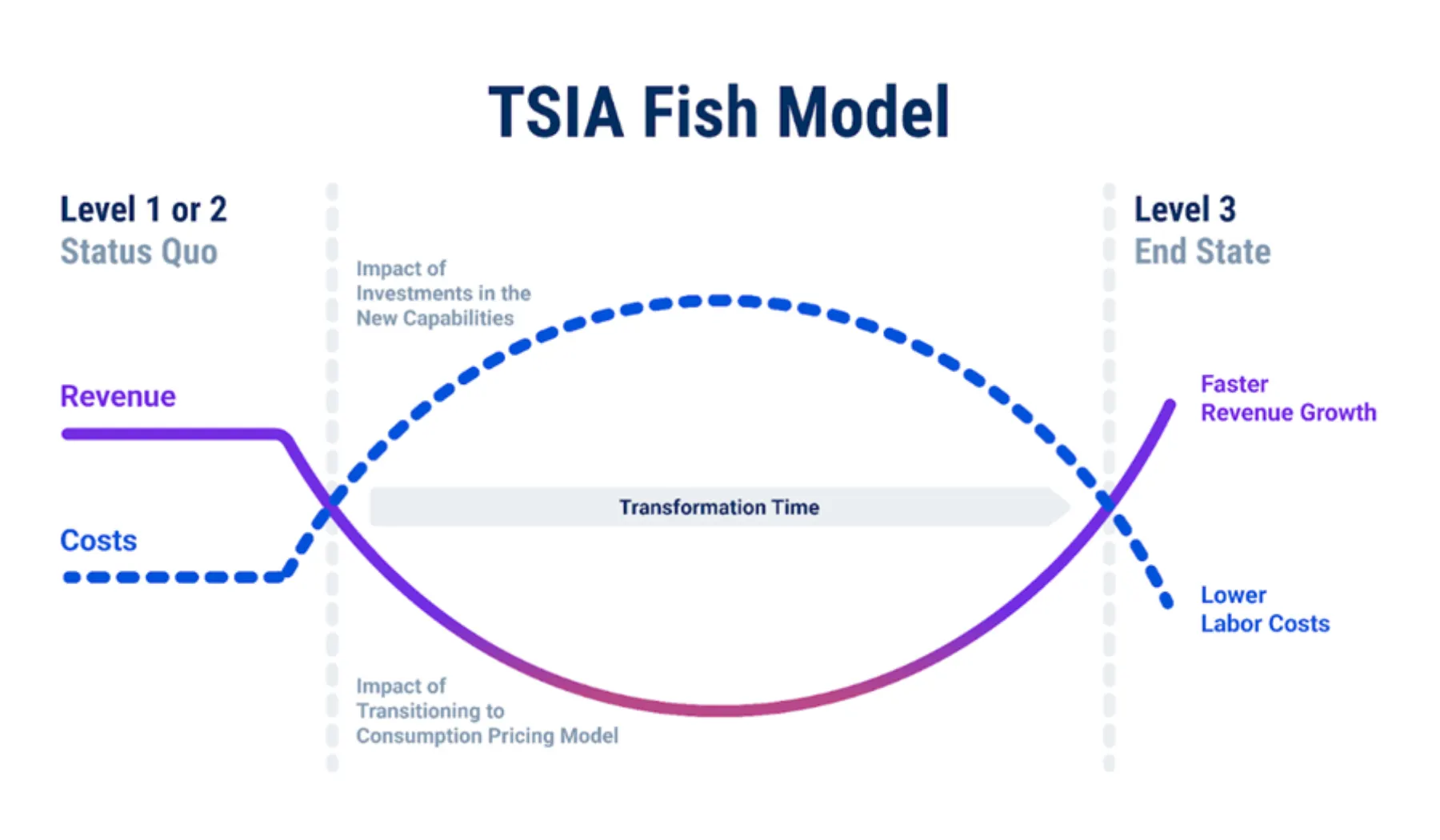
The same is true for ecosystems. Companies can see a dip in revenues—for example, when they shift from delivering their own professional services to relying on partners to drive product adoption, integration, and expansion. They can also see a temporary increase in costs due to the product and system changes needed to support different partner models, such as MSPs (Managed Service Providers). MSPs require multi-tenancy and pay-as-you-go consumption billing that many vendors don’t yet have.
Faster revenue growth occurs as partners gain experience—and success stories they can share with other customers. It comes from opening up new markets, such as being able to capture growth through MSPs. Product innovation by these partners will also add to that revenue growth.
Costs come down with partner delivery as the vendor can reduce their services’ labor costs and shift those resources to higher value-add roles, including Partner Success and Customer Success positions. Costs also reduce once the upfront investments have been made in products and systems to be more ecosystem-ready.
Conclusion: companies leveraging partner ecosystems are the winners in 2025 and beyond
The greatest results often come from the most challenging times. By swallowing the fish, 2025 can be the year that manufacturers, software vendors, and their partners start to truly capture the power and reap the rewards of an orchestrated partner ecosystem.
Click here to learn more about the Partner Trust ecosystem at BeyondTrust, and tune into the Channel Journeys Podcast to hear more of my insights on ecosystem strategies and partnering trends.
Recommended reading
Looking for more predictions-related content? Check out:
About the Author
Rob Spee
Rob Spee is the SVP of Global Channels and Alliances at BeyondTrust, where he leads a growing team to build a modern partner ecosystem. He is also the founder and CEO of Channel Journeys, and hosts the Channel Journeys podcast where he interviews other channel pros to explore best practices in partnering.
Rob is a guest speaker on other IT and channel podcasts, and guest blogs on numerous channel publications. He excels at creating visionary channel strategies that accelerate revenue growth and open new routes to market. He knows what it takes to build global partner ecosystems and performance-driven channel organizations. In fact he’s done that as a vendor, a reseller, and a distributor.
He enjoys sharing his passion for the channel, bringing new insights and innovation, and energizing his clients to excel.