
Alert icon Keyboard navigation enabled.
Alert icon TAB or Shift+TAB to navigate across. Down ↓ to open menu. ESC to close menu.
Alert icon Down ↓ to select section. Right → to activate. Up ↑ / Down ↓ / Tab to traverse all. ESC to exit.
BeyondTrust
Skip to content Use space or enter to skip.

What can we help you find today?

Instant Results
  • Website Results
  • Technical Documentation

Filter Options

Focus your search

Filtering by

Your recent searches:

Contact Us Chat with Sales Get Support
  • English
  • Deutsch
  • français
  • español
  • 한국어
  • português
  • Home
  • Resources
  • Blog
  • Secure Access and GDPR: Control and Monitor Access to Your Data current page
Link copied

Secure Access and GDPR: Control and Monitor Access to Your Data

Jun 28, 2018
Author:
Bomgar portraits Jan 17 1708
Karl Lankford
Director, Solutions Engineering
Blog banner default
Secure Access and GDPR: Control and Monitor Access to Your Data
Bomgar portraits Jan 17 1708
Karl Lankford
Director, Solutions Engineering


The EU general data protection regulation (GDPR) is now officially a month behind us. How has your organisation prepared to meet the requirements? Or better yet – is your organisation prepared?

What’s critical to understand is how these requirements will impact processes, policies, training, technology and security around the data that your organization gathers and processes. Compliance and the IT teams must be proactive to ensure they will be compliant, which doesn’t just apply to all organisations based in the EU, but also to any company that process data of EU citizens.

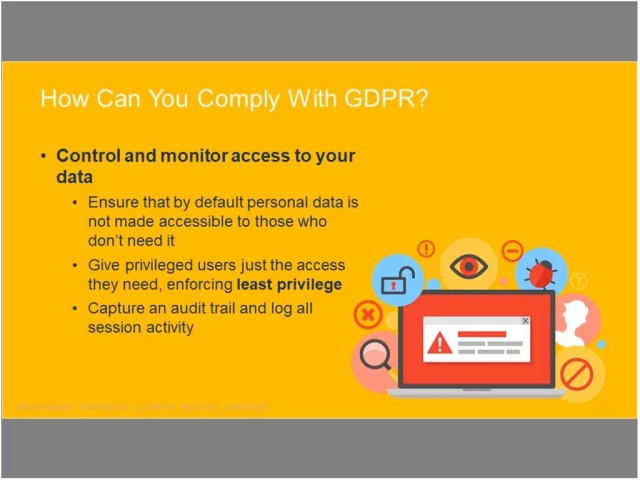
Bomgar has outlined four areas where organizations can start to secure remote access in order to help meet these new requirements and ensure data privacy. In the previous blogs in this series, we talked about the first step of identifying the data you hold, the second step of reviewing employee training and the third step of considering your supply chain. The fourth and final step – which could arguably be the most important – is to control and monitor access to your data. Here’s a clip from a webinar the shares more details:

Now that the GDPR enforcement date is behind us, organisations need to ensure that their remote access methods are secure to foster a mature security posture to ensure data security and data privacy.

Control and Monitor Access to Your Data

White chain icon to symbolize the ability to copy a link
Link copied
Check mark to visually show text has been copied

Ultimately a big part of being GDPR compliant when it comes to remote access is the understanding who has access to your data and actually controlling that access. You need to ensure that personal data is not made accessible to those who do not need it. For example, IT administrators have access to lots of different areas of the network. You may need to segregate some of those areas or perhaps delegate different sets of privileges and duties to different members of the team have only the access they need to perform their daily tasks.

Additionally, being able to capture a full recording and audit log of support sessions will ensure the integrity of your organization and that support team members are doing exactly what they’re supposed to do.

Now that the GDPR enforcement date is behind us, organisations need to ensure that their remote access methods are secure to foster a mature security posture to ensure data security and data privacy.

Karl Lankford / Sr. Solutions Engineer / Bomgar

Bomgar’s solutions are designed with privacy and security at their core. This ensures that every remote access connection made by our customers—whether an admin connecting to a critical server or a help desk technician connecting to an end-user’s desktop or device—is secure, protecting critical systems and data and helping organisations meet the GDPR requirements.

For more details on how secure access can help meet GDPR compliance, you can watch this webinar that gives an overview of Bomgar’s suggestions for evaluating your security posture to meet the new requirements.
GDPR and Remote Access Security: What You Need To Know

Webinars

GDPR and Remote Access Security: What You Need To Know

Latest Posts
  • The Most Common & Most Dangerous Types of Shadow IT
    Jun 5, 2026 The Most Common & Most Dangerous Types of Shadow IT
    Blog
    19m
  • 14 Password Management Best Practices
    May 28, 2026 14 Password Management Best Practices
    Blog
    12m
  • A Security Researcher’s Guide to Understanding Copilot Studio AI Agents
    May 26, 2026 A Security Researcher’s Guide to Understanding Copilot Studio AI Agents
    Blog
    3m
  • How to Secure Cloud-Native Infrastructure at Scale and Speed: A Conversation with Madhu Adireddi
    May 21, 2026 How to Secure Cloud-Native Infrastructure at Scale and Speed: A Conversation with Madhu Adireddi
    Blog
    5m
  • Cybersecurity as a Boardroom Priority for Major African TelCos
    May 12, 2026 Cybersecurity as a Boardroom Priority for Major African TelCos
    Blog
    8m
Related
  • Privileged Password Management Explained Part 1: Why You Need It
    Apr 20, 2017 Privileged Password Management Explained Part 1: Why You Need It
    Blog
    1m
  • The 2022 Edition of the Microsoft Vulnerabilities Report is Out – Despite Uneven Progress, a Picture of Elevated Vulnerabilities Remains
    May 25, 2022 The 2022 Edition of the Microsoft Vulnerabilities Report is Out – Despite Uneven Progress, a Picture of Elevated Vulnerabilities Remains
    Blog
    1m
Share this Article
  • Link
Stay up to Date
Get the latest news, ideas, and tactics from BeyondTrust. You may unsubscribe at any time.

Keep up with BeyondTrust

Customer Support Get Started
  • LinkedIn
  • X
  • Facebook
  • Instagram
  • Add BeyondTrust as a preferred source on Google
  • Privacy
  • Security
  • Manage Cookies
  • Do Not Sell My Data
  • WEEE Compliance

Copyright © 2003 — 2026 BeyondTrust Corporation. All rights reserved. Other trademarks identified on this page are owned by their respective owners. BeyondTrust Corporation is not a chartered bank or trust company, or depository institution. It is not authorized to accept deposits or trust accounts and is not licensed or regulated by any state or federal banking authority.

Prefers reduced motion setting detected. Animations will now be reduced as a result.