

Alert icon Keyboard navigation enabled.
Alert icon TAB or Shift+TAB to navigate across. Down ↓ to open menu. ESC to close menu.
Alert icon Down ↓ to select section. Right → to activate. Up ↑ / Down ↓ / Tab to traverse all. ESC to exit.
BeyondTrust
Skip to content Use space or enter to skip.

What can we help you find today?

Instant Results
  • Website Results
  • Technical Documentation

Filter Options

Focus your search

Filtering by

Your recent searches:

Contact Us Chat with Sales Get Support
  • English
  • Deutsch
  • français
  • español
  • 한국어
  • português
  • Home
  • Resources
  • Blog
  • BeyondTrust Defendpoint Version 5.3 Introduces Power Rules to Automate Workflows and Speed Application Exception Handling current page
Link copied

BeyondTrust Defendpoint Version 5.3 Introduces Power Rules to Automate Workflows and Speed Application Exception Handling

Jan 23, 2019
Author:
Kris Zentek
Kris Zentek
Senior Product Manager
Blog banner default
BeyondTrust Defendpoint Version 5.3 Introduces Power Rules to Automate Workflows and Speed Application Exception Handling
Kris Zentek
Kris Zentek
Senior Product Manager

We are pleased to announce the 5.3 release of BeyondTrust Defendpoint, our market-leading solution for enabling users and administrators to work securely and efficiently—without the need for Windows admin rights. Version 5.3 introduces Power Rules, a business rules engine that enables customers to more easily configure Defendpoint to their unique business requirements and integrate Defendpoint into other systems. Power Rules helps speed decisions on whether to allow an application to run, or allow it to run with admin rights, by automating the integration of third party intelligence sources.

Based on PowerShell, organizations can simply write a script and embed it in the policy itself. For example, when it runs, the PowerShell script can automatically trigger a service desk workflow, raising a ticket with your helpdesk that provides all of the information they require about the application or task. Or, it can call out to a third party to check the hash, or to a vulnerability management system to check for CVEs on the application, thereby adding custom logic to building Defendpoint rules.

Power Rules for ServiceNow

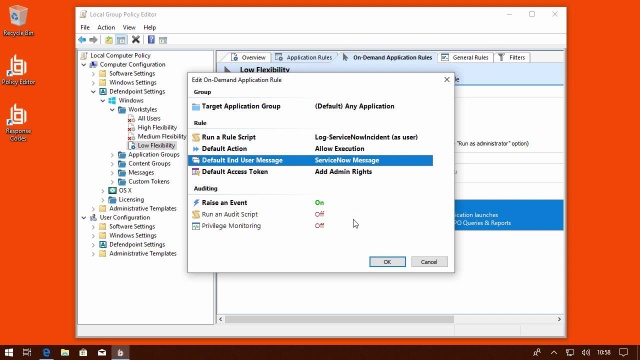
The first Power Rules integration available is with ServiceNow. This integration enables the submission of a ticket to the IT team, so that they can make an informed and expedited decision on the user’s request to run an application, installation, script, or task.

In the default configuration, when a user runs an application that you are targeting with the ServiceNow Rule Script, the user is presented with the option to raise an incident in ServiceNow or cancel the request. The ServiceNow ticket includes caller, a short description, and a complete description that includes the business justification, the program name, program publisher, program path, challenge code, and the business justification the end user provided.

Administrators can then take action on the incident in ServiceNow and supply the end user with a response code. The end user can then use the response code to 'unlock' the application, allowing it to run.

Using the ServiceNow integration is simple - just create a new Power Rule in any workstyle or set any existing rule to use a Power Rule and import the integration script. Any application that matches the rule will then trigger your ServiceNow workflow. And because the integration is scripted, it can easily be tailored based on your own ServiceNow workflows.
Latest Posts
  • Hooked on Identity (Part 2): Abusing OAuth Trust Boundaries in Okta
    Jun 12, 2026 Hooked on Identity (Part 2): Abusing OAuth Trust Boundaries in Okta
    Blog
    7m
  • Hooked on Identity: Abusing SAML Assertion Inline Hooks in Okta
    Jun 9, 2026 Hooked on Identity: Abusing SAML Assertion Inline Hooks in Okta
    Blog
    6m
  • Joining Project Glasswing: Securing the Privilege Backbone of the AI Era
    Jun 8, 2026 Joining Project Glasswing: Securing the Privilege Backbone of the AI Era
    Blog
    5m
  • The Most Common & Most Dangerous Types of Shadow IT
    Jun 5, 2026 The Most Common & Most Dangerous Types of Shadow IT
    Blog
    19m
  • 14 Password Management Best Practices
    May 28, 2026 14 Password Management Best Practices
    Blog
    12m
Related
  • Privileged Remote Access 22.1 Introduces New Features to Better Secure Your IT/OT Environments
    Jan 20, 2022 Privileged Remote Access 22.1 Introduces New Features to Better Secure Your IT/OT Environments
    Blog
    1m
  • How Universal Privilege Management Secures Digital Transformation
    Jul 6, 2021 How Universal Privilege Management Secures Digital Transformation
    Blog
    1m
Share this Article
  • Link
Stay up to Date
Get the latest news, ideas, and tactics from BeyondTrust. You may unsubscribe at any time.

Keep up with BeyondTrust

Customer Support Get Started
  • LinkedIn
  • X
  • Facebook
  • Instagram
  • Add BeyondTrust as a preferred source on Google
  • Privacy
  • Security
  • Manage Cookies
  • Do Not Sell My Data
  • WEEE Compliance

Copyright © 2003 — 2026 BeyondTrust Corporation. All rights reserved. Other trademarks identified on this page are owned by their respective owners. BeyondTrust Corporation is not a chartered bank or trust company, or depository institution. It is not authorized to accept deposits or trust accounts and is not licensed or regulated by any state or federal banking authority.

Prefers reduced motion setting detected. Animations will now be reduced as a result.